

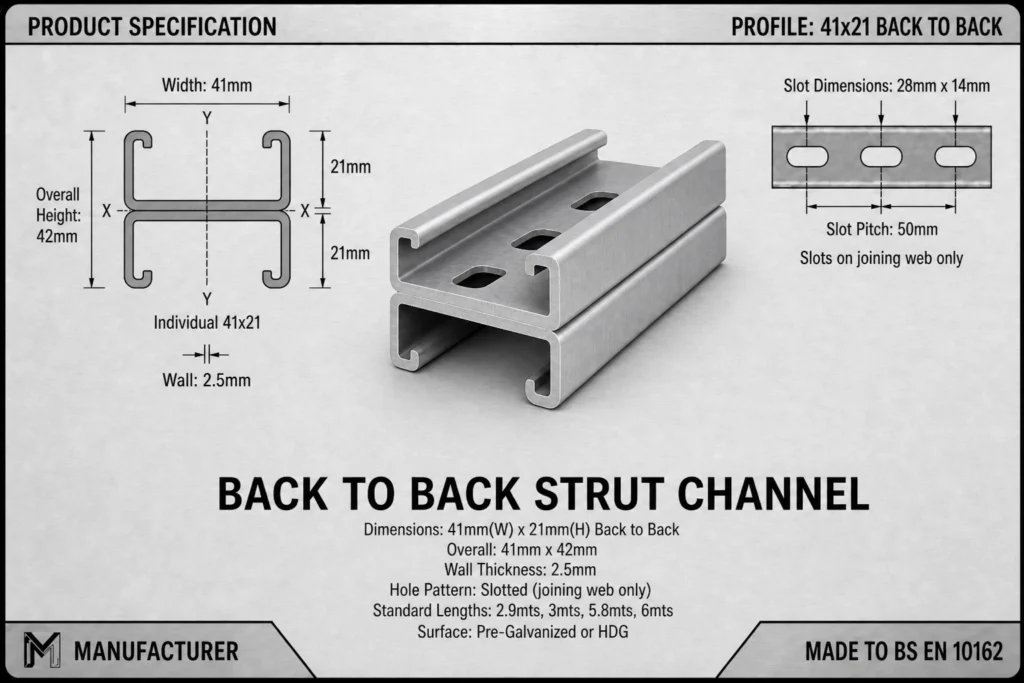
Back-to-Back Strut Channel 41x42mm
The Back-to-Back Strut Channel 41×42 mm is manufactured by spot-welding two 41×21 mm slotted steel channels into a rigid 41×42 mm box-section profile. It delivers higher bending stiffness and torsional rigidity than a single half-size channel, while remaining more compact than the 41×82 mm twin 41×41 system. Compatible with Unistrut-type channel nuts, brackets, and fittings for fast, adjustable MEP installation.



General information
Product Features
- Compact box-section strength — Two 41×21 mm channels spot-welded at the web form a 41×42 mm profile with significantly higher bending stiffness and torsional rigidity than a single half-size channel
- Space-efficient alternative to 41×82 — Lower overall depth (42 mm vs 82 mm) for ceiling plenums, congested plant rooms, and secondary support tiers
- Continuous slotted design — Elongated slots accept channel nuts and spring nuts at any point for flexible, tool-free alignment
- Multi-finish corrosion protection — Pre-galvanized, hot-dip galvanized, stainless steel 304/316, and aluminum for indoor, outdoor, coastal, and industrial environments
- Fast, adjustable installation — Compatible with major Unistrut-type (P1000/P1001) brackets, beam clamps, trapeze hangers, and pipe supports
- Flexible lengths and specifications — Standard 3 m and 6 m lengths; custom cut-to-size, thickness, and slot patterns available on request
Dimensions & Specifications
Typical profile dimensions (indicative):
| Parameter | Specification |
| Profile type | Back-to-back slotted strut channel |
| Profile Size | 41 × 42 mm (2 × 41 × 21 mm spot-welded back-to-back) |
| Single Channel | 41 × 21 mm (13/16″ × 1-5/8″) |
| Material Thickness | 1.1mm to 3mm custom thickness available |
| Slot Spacing | 50 mm centre-to-centre (typical) |
| Slot Size (typical) | 14 × 28 mm (stock-dependent) |
| Material | Carbon steel (mild steel); optional stainless steel 304/316 or aluminum |
| Finishes | Pre-galvanized (PG) / Hot-dip galvanized (HDG) / Powder coated |
| Construction | Resistance spot-welded at web |
| Standard Length | 3 m / 6 m (custom lengths available) |
| Profile Type | Slotted (elongated holes) or plain (solid) |
Technical Specifications
- Surface protection: Pre-galvanized (ASTM A653), hot-dip galvanized (ASTM A123 / ISO 1461), stainless steel 304/316, or powder coat (RAL colours) for project-specific environments
- Load capacity: Significantly higher than a single 41×21 mm channel; industry-equivalent B52A achieves approximately 4.5 kN uniform load at 914 mm span (1/240 deflection). Verify actual loads against span, bracing, and support conditions
- Slot design: Continuous slotted lips with inturned edges for secure channel nut retention; fittings attach at any point along the length
- Dimensional tolerance: Cold-formed to consistent profile dimensions per BS 6946 manufacturing practice
- Structural integrity: Back-to-back spot welding creates a closed box-section with improved resistance to twisting and lateral deflection
- Thermal expansion: Suitable for indoor and outdoor installations; allow expansion gaps on long runs per project engineering requirements
- Cold-climate suitability: Rigid steel construction performs reliably in low-temperature industrial environments when specified with appropriate finish and fasteners
Surface Treatment Options
Different finishes are available for various environments.
| Aspect | Powder Coated | Pre-Galvanized (PG) | Hot Dip Galvanized (HDG) |
|---|---|---|---|
| Primary Objective | Corrosion protection & aesthetics | Cost-effective corrosion protection for indoor use | Heavy-duty corrosion protection, weather resistance |
| Surface Material / Treatment | Standard polyester, epoxy, or hybrid powder (organic polymers) | Zinc-coated steel sheet (pre-galvanized coil) | Zinc-iron alloy layer (pure zinc by hot-dip process) |
| Process | Electrostatic spray deposition + heat curing | Continuous galvanizing before forming | Immersion in molten zinc bath (~445 °C) forming metallurgical bond(pre-fabrication) |
| Coating Thickness | 60–120 µm | Typically 10–30 μm | Typically ≥65 µm (can be increased for aggressive environments) |
| Fire Performance | Combustible, produces smoke, no cable protection | Non-combustible (steel base) | Non-combustible (steel base), but no thermal insulation; zinc may vaporize under intense fire, cables still damaged |
| Corrosion Protection | Moderate (indoor, dry environments) | Moderate (indoor, dry environments) | Excellent (suitable for outdoor, marine, salt spray, chemical plants) |
| Surface Finish | Smooth, uniform gloss, wide colour range | Smooth, metallic, uniform | Dull silver-grey, may have zinc spangles or runs |
| Governing Standards | IEC 61537 | IEC 61537, EN 10346 | IEC 61537, ISO 1461 / ASTM A123 |
| Typical Applications | General indoor, offices, commercial spaces without special fire or severe corrosion | Indoor installations, commercial buildings | Outdoor cable trenches, coastal facilities, wastewater treatment, chemical plants, high humidity / high temperature areas |
| Relative Cost | Low | Low | Medium-high |
Applicable standards:
- ISO 9001 — Quality management system
- BS 6946:1988 — Slotted steel channel systems
- IEC 61537 — Cable tray systems and cable ladder systems (when used as tray support)
- ASTM A653 — Pre-galvanized steel sheet
- ASTM A123 / A123M — Hot-dip galvanized coatings
- UL 2239 — Hardware for the support of conduit, tubing, and cable
- NEMA VE 1 — Metal cable tray systems
- MFMA — Metal framing load design practice
Technical Description
The Back-to-Back Strut Channel 41×42 mm is produced from two identical 41×21 mm cold-formed slotted channels, joined back-to-back at the web by automated resistance spot welding. The resulting 41 × 42 mm box-section delivers higher section modulus and torsional rigidity than a single half-size channel, enabling longer spans or higher loads in the same 41 mm width footprint.
Weld spacing is controlled at 63.5–101.6 mm (2.5–4 in.) on centre, consistent with major international manufacturers such as Eaton B-Line. The profile is industry-equivalent to the Eaton B52A series (two B52 half channels welded back-to-back).
Compared with the 41×82 mm system (two 41×41 mm channels), the 41×42 mm profile is the compact choice for ceiling plenums, secondary support tiers, light-to-medium cable bundles, and installations where headroom is limited but stiffness beyond a single 41×21 channel is still required.
Applications
- Cable tray and wire mesh tray trapeze supports
- Light-to-medium pipe and conduit routing
- HVAC duct and equipment hangers
- Ceiling grid and suspended services in commercial buildings
- Solar panel mounting sub-structures (where 41×42 profile meets load requirements)
- Modular equipment frames, skids, and maintenance platforms
- Industrial plants in cold-climate and high-latitude regions requiring compact, rigid steel framing
Customization
- Custom lengths (cut-to-size)
- Plain (non-slotted) or slotted profiles
- Material options: carbon steel, stainless steel 304/316, aluminum
- Finish options: PG, HDG, powder coat (RAL colours)
- Custom slot spacing, hole patterns, and lip configuration to drawing
- Pre-assembled trapeze sets, cantilever brackets, and welded combinations
- Export packaging: bundled, palletized, or wooden crate
Back-to-Back Strut Channel 41x42mm FAQ FAQs
Click a question to reveal the answer.
The back-to-back strut channel is formed by spot-welding two 41×21 mm slotted steel channels into a rigid 41×42 mm box-section profile. The standard material thickness is 2.0 mm, while a 2.5 mm option is available for heavy-duty configurations. Standard length is 3 000 mm, with custom lengths available upon request. Elongated slots measure 14 mm × 28 mm and are spaced at 50 mm intervals. These dimensions conform to IEC 61537, and dimensional tolerances are verified by type testing at accredited third-party laboratories.
The 41×42 mm back-to-back configuration delivers significantly higher bending stiffness and torsional rigidity compared to a single 41×21 mm channel. By welding two half-size channels into a closed box-section, the profile resists twisting and deflection more effectively under medium-load conditions. This makes it suitable for MEP support, cable tray hangers, and pipe routing where structural integrity is critical, yet the overall depth remains only 42 mm—more compact than the 41×82 mm twin 41×41 system—allowing installation in space-limited runs without sacrificing load-bearing capacity.
The 41×42 mm back-to-back strut channel conforms to several international standards governing design, material, and safety. These include IEC 61537 for cable tray and cable ladder systems, BS 6946 for metal channel support systems, ASTM A653 for steel sheet zinc-coated by the hot-dip process, ASTM A123 for hot-dip galvanized coatings, UL 2239 for hardware for the support of conduit and cable, and NEMA VE 1 for metal cable tray systems. Compliance is substantiated through type testing at accredited third-party laboratories, ensuring reliable performance in building wiring and industrial installations.
Multiple corrosion-resistant finishes are offered to suit different environmental conditions. Options include pre-galvanized (zinc-coated steel sheet conforming to ASTM A653), hot-dip galvanized after fabrication (meeting ASTM A123 requirements for thicker zinc coverage), stainless steel for superior corrosion resistance in harsh or wash-down environments, and aluminum for lightweight applications requiring natural oxidation resistance. The selection of finish should be based on the installation environment’s corrosivity category, with hot-dip galvanized or stainless steel recommended for outdoor and high-humidity locations to maintain structural integrity over time.
Yes, the 41×42 mm back-to-back strut channel is designed as a Unistrut-compatible system and works with standard 41 mm channel nuts, brackets, and MEP accessories. The 14 mm × 28 mm elongated slots accept conventional spring nuts and toothed channel nuts, enabling fast, adjustable connections without field drilling. This compatibility allows engineers and installers to integrate the channel into existing modular framing and support assemblies using widely available fittings, reducing procurement complexity. Chinne Electric confirms that all slot geometry and dimensional tolerances align with the interface requirements specified in IEC 61537 for interoperable channel support systems.