

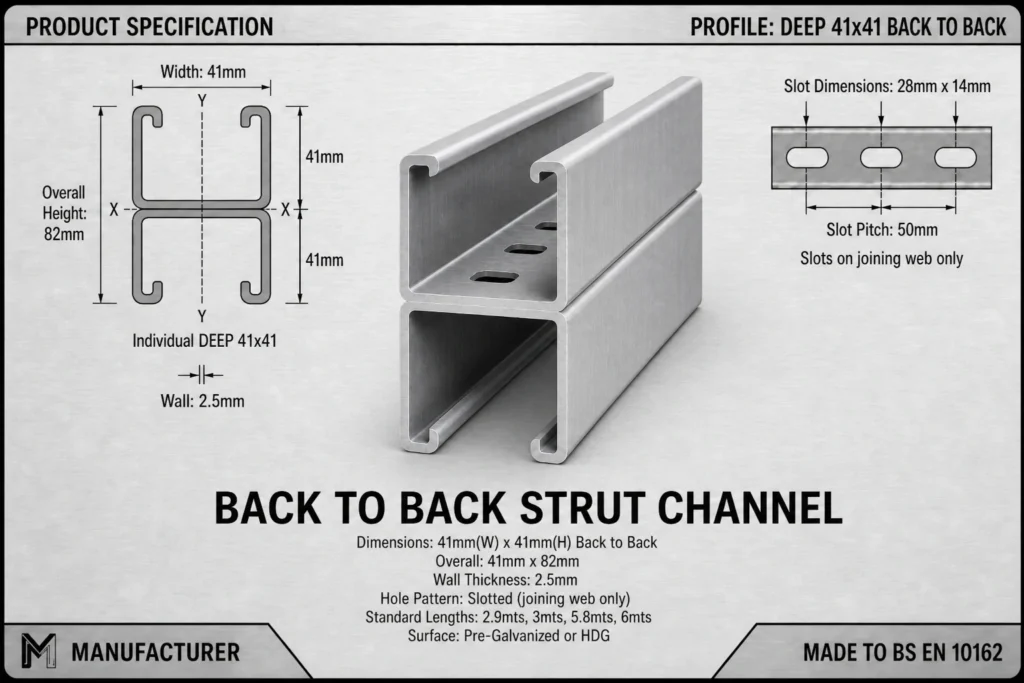
Back-to-Back Strut Channel 41x82mm
Chinne Electric Back-to-Back Strut Channel 41×82mm combines two standard 41×41 mm slotted channels welded face-to-face to create an 82 mm deep composite section with significantly higher bending stiffness and load capacity than single-channel profiles. Ideal for heavy cable tray runs, large-bore pipe supports, equipment mounting frames, and vertical column applications where deflection control and structural rigidity are critical.



General information
Product Features
- High structural rigidity — Back-to-back construction doubles section depth to 82 mm, delivering substantially higher moment resistance than single 41×21 mm or 41×41 mm profiles.
- Universal slotted pattern — Standard 14×28 mm slots on both channel faces allow bolt-through connections, multi-directional fittings, and rapid field adjustment without drilling.
- Full accessory compatibility — Works with the complete range of 41 mm strut fittings: spring nuts, channel nuts, beam clamps, pipe clamps, base plates, and cantilever arms.
- Heavy-duty material options — Cold-formed steel in 2.0 mm, 2.5 mm, and 3.0 mm gauges; stainless steel grades available for corrosive environments.
- Flexible lengths and finishes — Supplied in standard 3 m and 6 m lengths with custom cut-to-length and bespoke hole patterns on request.
Dimensions & Specifications
Typical profile dimensions (indicative):
| Parameter | Specification |
| Profile type | Back-to-back slotted strut channel |
| Nominal width | 41 mm |
| Overall height | 82 mm (two 41×41 mm channels joined) |
| Slot spacing | 100 mm centre-to-centre (standard) |
| Slot size | 14 × 28 mm |
| Thickness | 1.1mm to 3mm |
| Standard lengths | 3 mts / 6 mts (custom lengths available) |
| Custom lengths | Available on request |
Technical Specifications
- Section properties — The 82 mm composite depth provides a section modulus approximately 4× that of a single 41×41 mm channel, making it suitable for column applications and long-span cantilever supports.
- Load capacity — Safe working loads depend on span, support spacing, load type (point vs. distributed), and material gauge; refer to the load capacity chart in the product datasheet or contact Chinne Electric for project-specific calculations.
- Yield strength — Minimum 280 MPa (pre-galvanized) / 350 MPa (high-strength option) per EN 10147.
- Connection method — Channels are continuously welded along the full length at the back face; weld bead does not interfere with slot access on either face.
- Fire performance — Non-combustible steel construction; suitable for use in fire-rated shafts and plant rooms when installed per project fire-stopping requirements.
- Thermal expansion — Allow approximately 1.2 mm per metre per 10 °C temperature change; use sliding or slotted connections at expansion joints on runs exceeding 30 m.
Surface Treatment Options
Different finishes are available for various environments.
| Aspect | Powder Coated | Pre-Galvanized (PG) | Hot Dip Galvanized (HDG) |
|---|---|---|---|
| Primary Objective | Corrosion protection & aesthetics | Cost-effective corrosion protection for indoor use | Heavy-duty corrosion protection, weather resistance |
| Surface Material / Treatment | Standard polyester, epoxy, or hybrid powder (organic polymers) | Zinc-coated steel sheet (pre-galvanized coil) | Zinc-iron alloy layer (pure zinc by hot-dip process) |
| Process | Electrostatic spray deposition + heat curing | Continuous galvanizing before forming | Immersion in molten zinc bath (~445 °C) forming metallurgical bond(pre-fabrication) |
| Coating Thickness | 60–120 µm | Typically 10–30 μm | Typically ≥65 µm (can be increased for aggressive environments) |
| Fire Performance | Combustible, produces smoke, no cable protection | Non-combustible (steel base) | Non-combustible (steel base), but no thermal insulation; zinc may vaporize under intense fire, cables still damaged |
| Corrosion Protection | Moderate (indoor, dry environments) | Moderate (indoor, dry environments) | Excellent (suitable for outdoor, marine, salt spray, chemical plants) |
| Surface Finish | Smooth, uniform gloss, wide colour range | Smooth, metallic, uniform | Dull silver-grey, may have zinc spangles or runs |
| Governing Standards | IEC 61537 | IEC 61537, EN 10346 | IEC 61537, ISO 1461 / ASTM A123 |
| Typical Applications | General indoor, offices, commercial spaces without special fire or severe corrosion | Indoor installations, commercial buildings | Outdoor cable trenches, coastal facilities, wastewater treatment, chemical plants, high humidity / high temperature areas |
| Relative Cost | Low | Low | Medium-high |
Applicable standards:
- IEC 61537 — Cable management — Cable tray systems and cable ladder systems
- GB/T 23639-2017 — Electrical installations — Cable tray systems
- JB/T 10216-2013 — Electric cable tray (national machinery industry standard)
- EN 10162 — Cold-rolled steel sections — Technical delivery conditions
- EN 10147 — Continuously hot-dip zinc-coated structural steels
- BS 6946 — Method for conversion of elongation values for cold-formed structural hollow sections
- GB/T 13912 — Hot-dip galvanized coatings on fabricated iron and steel articles
Technical Description
Back-to-Back Strut Channel 41×82mm is manufactured by joining two identical 41×41 mm slotted strut channels along their back faces using continuous fillet welding. This composite profile retains full slot access on both outward-facing sides, so all standard 41 mm fittings, spring nuts, and channel nuts can be installed from either face without modification.
The 82 mm overall depth dramatically increases the section’s moment of inertia compared to single-channel profiles. In practical terms, a back-to-back assembly can support significantly heavier loads at the same span, or achieve the same load capacity at longer spans with less deflection. This makes the profile the preferred choice for vertical column supports, multi-tier cable tray structures, large-bore pipe racks, and seismic bracing frames where stiffness and stability under dynamic loads are essential.
Chinne Electric produces this profile using precision cold-roll forming from high-quality galvanized coil steel. Slot punching is performed before assembly to ensure clean edges and consistent slot geometry. After welding, hot-dip galvanized and stainless steel versions undergo their respective finishing processes. Every batch is dimensionally inspected against EN 10162 tolerances before dispatch.
Applications
- Heavy-duty cable tray and cable ladder support structures (multi-tier installations)
- Large-bore pipe and duct support racks in industrial plants and power stations
- Vertical column framing for rooftop equipment, HVAC plant, and solar PV mounting
- Seismic and lateral bracing for MEP services in earthquake-prone regions
- Modular equipment frames, machine bases, and conveyor support structures
- Overhead support grids in data centres, clean rooms, and commercial plant rooms
- Bridge and tunnel MEP service corridors requiring high load capacity and rigidity
- Temporary and permanent scaffolding for industrial maintenance access
Customization
Chinne Electric offers the following bespoke options for Back-to-Back Strut Channel 41×82mm:
- Custom lengths — Cut to any length from 500 mm to 12 m; bundling and labelling per project requirements
- Special slot patterns — Modified slot spacing, end-slot positioning, or solid (unslotted) end sections
- Pre-drilled connection holes — Factory-punched bolt holes at specified centres for repeat assembly
- Material upgrades — S350GD+Z high-strength steel, SS304, SS316L, or duplex stainless on request
- Surface finish — Powder coating in RAL colours over galvanized substrate for aesthetic or colour-coded installations
- Kit assembly — Pre-cut and pre-fitted channel sets with nuts, bolts, and fittings for faster on-site installation
Contact the Chinne Electric sales team with your project drawings for a tailored quotation.
Back-to-Back Strut Channel 41x82mm FAQ FAQs
Click a question to reveal the answer.
The 41x82mm back-to-back strut channel, formed by welding two 41x41mm channels face-to-face, delivers a substantially higher section modulus and bending stiffness than a single 41x41mm profile. While exact allowable loads depend on span, support conditions, and safety factors defined in IEC 61537, the composite 82mm depth typically increases beam load capacity by a factor of four to six under uniform loading. Type-tested mechanical load data verified by accredited third-party laboratories confirms that the dual-channel configuration effectively controls deflection in heavy-duty applications such as large-bore pipe supports and multi-tier cable tray runs. Engineers should consult the manufacturer’s beam load tables derived from IEC 61537 test procedures to determine permissible stress and deflection limits for specific unsupported spans.
The Chinne Electric 41x82mm back-to-back strut channel is designed and tested to conform to the dimensional and performance requirements of IEC 61537, the international standard for cable tray and cable ladder systems. Additionally, the product aligns with GB/T 23639-2017 for energy-efficient strut channels, EN 10162 for cold-rolled steel sections, and BS 6946 for metal channel support systems. Compliance is validated through type testing at accredited third-party laboratories, covering dimensional tolerances, material grades, and mechanical load capacity. The standard material thickness is 2.0 mm, with a 2.5 mm option available for heavy-duty configurations, ensuring structural integrity across indoor and outdoor installations when paired with the appropriate pre-galvanized, hot-dip galvanized, or stainless steel finish.
The back-to-back strut channel features a composite profile measuring 41 mm in height by 82 mm in depth, created by joining two 41x41 mm slotted channels. The standard material thickness is 2.0 mm, with a 2.5 mm heavy-duty option available. Channels are supplied in a standard length of 3 000 mm, with custom lengths available upon request. Both faces incorporate elongated slots measuring 14 mm by 28 mm, spaced at 50 mm intervals along the channel length, enabling flexible fastener positioning and on-site adjustment for MEP supports and structural framing. These slot dimensions are consistent with common industry hardware, allowing the use of standard T-bolts and channel nuts to secure pipe clamps, cable tray brackets, and equipment mounting plates without field drilling.
The 41x82mm back-to-back strut channel is available in pre-galvanized, hot-dip galvanized, and stainless steel finishes to suit varying environmental conditions. Pre-galvanized steel, conforming to EN 10162, provides economical corrosion protection for indoor electrical and mechanical installations. Hot-dip galvanized steel offers a thicker zinc coating suitable for outdoor service and moderately corrosive industrial atmospheres. Stainless steel grades are specified for highly corrosive environments such as chemical plants, wastewater treatment facilities, and coastal installations where chloride-induced corrosion resistance is critical. The selection of finish should be based on the ISO 9223 atmospheric corrosivity category of the installation site, ensuring long-term structural integrity and compliance with the service life requirements of IEC 61537.
The 41x82mm back-to-back strut channel is engineered for heavy-duty MEP support applications where high load capacity and deflection control are critical. Typical installations include trapeze-style cable tray supports spanning wide column bays, multi-tier pipe racks carrying large-bore chilled water or steam lines, equipment mounting frames for air handling units and electrical panels, and vertical column applications requiring high axial stiffness. The slotted design on both faces allows installers to attach brackets, clamps, and connectors from either side without repositioning the channel, significantly reducing installation time. When configured as continuous beam spans with cantilevered ends, the 82 mm depth effectively resists bending moments induced by concentrated loads from heavy valves, in-line pumps, and cable bundles, maintaining alignment within the deflection limits prescribed by IEC 61537.